Research · White paper

MPAE — the structural taxonomy of the offshore fleet.

A measurement-grounded taxonomy for the global ORC fleet. Built on 9,591 scored ORC boats of 11,207 analyzed (July 2026). The structural map underneath every conversation about how offshore boats differ.

Photography: FleetEdge™ / SailrScience archive.

What MPAE is

The Multi-Dimensional Performance Archetype Engine (MPAE) is SailrScience's classification system for offshore racing yachts. It organizes the global fleet into physically meaningful design families using naval-architecture inputs — not race results.

The archetypes are discovered, not designed. Eleven of them. They were not chosen top-down; they emerged from the measurements. Their boundaries have held up under cross-validation, across regions, across class systems, and across more than four years of new certificates.

MPAE doesn't predict who will win a race. It says, with structural clarity, what kind of boat is this — the precondition for every other useful question.

One fingerprint per boat

Every boat in the system is described along a small set of interpretable axes. Together they form a vessel fingerprint — a compact summary of structural identity, realized behavior, and inventory-driven mode.

Structural identity

What kind of boat is this?

Eleven stable archetypes — AEROMAX (pure upwind power), KEELFLEX (form-stability specialist), HEADFORCE (head-driven reaching platform), and eight more. Each boat is anchored so the same certificate lands in the same archetype across builds and across years.

Expression

Realized vs. potential

How strongly does the boat behave like its archetype? The fingerprint captures heel behavior, drive efficiency, and balance — the reason two "similar" boats don't feel the same on the water.

Wardrobe

Inventory-driven behavior

What does the boat actually carry? The sail inventory shapes close-reach power, downwind punch, and crew-effort profile — the same hull sails differently depending on its wardrobe.

How MPAE is constructed

MPAE is grounded in naval-architecture practice. Three properties define it:

  • Measurement-grounded. Inputs are structural parameters drawn from every ORC certificate — hull form, stability, rig geometry, drive efficiency, heel behavior, CE–CLR alignment — not race results.
  • Independent axes. The fleet differs along a small number of independent structural axes. Most certificate fields are correlated; the fingerprint is built on the ones that are not.
  • Stable by construction. The eleven archetypes are anchored so that the same boat receives the same assignment across builds, across releases, and across years. The result is a taxonomy that is repeatable, auditable, and physically interpretable.

The full methodology is documented in the white paper.

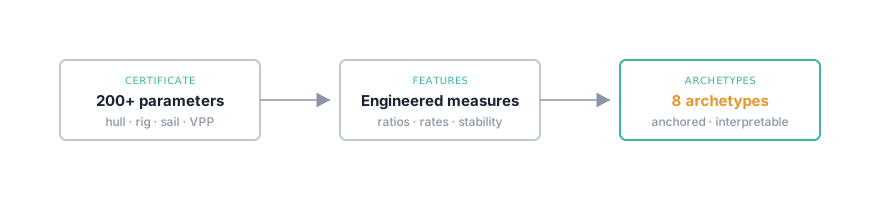
MPAE architecture: ORC certificate parameters are transformed into engineered physical measures, from which each boat's archetype assignment emerges.

What MPAE is for

MPAE complements existing naval-architecture and analytics tools; it doesn't replace them.

With ORC VPP

MPAE adds structural identity to the physics. The VPP says how fast; MPAE says what kind.

With CFD and DSYHS

MPAE provides archetype-level context for flow, resistance, and stability studies — a fleet-scale frame around per-boat numerical work.

With race analytics

MPAE separates structure from realized performance from inventory choices, so race analytics can read each layer on its own terms.

MPAE is not a rating rule, a handicap system, or a tactical AI. It's the structural map underneath those conversations.

Read the full methodology

The white paper — Understanding the MPAE Fleet Archetypes: A Practical Guide for Naval Architects, Sailmakers, and Racing Teams — documents the eleven fleet archetypes, the measurement framework behind them, and their practical applications for design, sailmaking, and racing professionals.

Submit your details below and we’ll send a one-time download link to the email address you provide. The link is good for seven days.

We use your email to deliver the link and may contact you about MPAE-related research. See our Privacy notice.

Prefer email? Send a note to contact@sailr.science and we’ll send the link manually.

In FleetEdge and SailEdge

The structural foundation surfaces inside both SailrScience products.

FleetEdge™

Uses MPAE fingerprints to compare boats within and across archetypes, interpret cohort-conditioned performance reads, and explain why a platform behaves the way it does. The eleven archetypes are the structural backbone of the FleetEdge analytics surface.

FleetEdge fleet archetypes · FleetEdge methodology

SailEdge™

Uses the same structural foundation to build physics-aware composites — drive, heel, balance — that feed into per-boat analytics and visualization.

Visit SailEdge

Discuss the model

For researchers, naval architects, journalists, and institutional contacts: the research arm responds to questions about the model and the methodology.