
Services · For Naval Architects

Physics validation and fleet benchmarking for naval architecture firms.

Designs are validated against reference data. With SailrScience, designs are also validated against the fleet — by archetype placement (which of the eight measured trades the design lands on), by polar comparison, by historical race performance.

Photography: SailrScience archive.

Prefer to self-serve? FleetEdge™ and SailEdge™ are the products. This page is the custom naval-architecture services layer above them.

The job

A naval architecture firm working on a new offshore design has every tool the discipline gives it: VPP, CFD, tank tests, parametric studies. What it usually doesn’t have is the rest of the fleet next to that design — the 9,591 ORC boats scored (11,207 analyzed within a 12,965-boat governed corpus, July 2026), the 8 performance archetypes those measurements reveal, the race history that shows which design choices have actually paid in which conditions.

SailrScience supplies that layer. The model places every other measured boat. It places your design. It tells you where the design wins and where it falls apart.

SailrScience does not replace VPP, CFD, tank testing, or design judgment. It adds the comparative and operational layer those tools do not carry: where a design sits in the fleet’s trade space, how its choices have paid in the measured fleet, what it reveals after launch, and how one validated platform calibration serves the designer, owner, and sailmaker through the boat’s competitive life.

What SailrScience provides

Hull validation

Place a design on the archetype map. Compare predicted polars against the fleet archetype median. Identify where the design departs from the cluster and verify whether the departure is intentional. When the question is an appendage, run a perturbation-study preview with SailEdge before the work order is written.
Archetype placement

The MPAE archetype model decomposes how offshore boats actually vary — not by marketing category but by measured geometry, sail-plan, and stability profile. Name where a design should live; the archetype map shows where it actually lands.

Fleet benchmarking

Race results across 9,591 ORC boats scored (July 2026), weather-conditioned and archetype-conditioned. A given design choice can be benchmarked against every comparable boat that has ever raced with the choice in those conditions.

Custom MPAE analysis

Bespoke decompositions for design questions the standard archetype model does not answer — new rating systems, novel hull forms, mixed-fleet handicap targets. Engineered to the question.

Stability data that states its own authority

Physics R16 extends the engine to righting moment and heel behavior at real sailing angles, derived from the ORC certificate alone. The results are graded, not asserted: every number carries a stated confidence level, and a boat the evidence cannot support is refused with the reason given. SailrScience holds that a refusal a firm can cite is worth more than a figure it cannot defend.

A first for ORC fleets (as of August 2026): certificate-derived stability, graded for confidence. Cohort and competitor studies proceed for the boats whose hull files were never going to be available.

The stability layer now states the sailing condition behind each result. Following the principles ORC publishes for its VPP — righting moment computed per boat, progressive depowering of the rig, sail changes recognized as the wind builds — the engine reports each boat’s reference sailing state: balanced naturally, balanced after modeled depower, balanced after a modeled sail change from the rated inventory, or honestly outside the modeled envelope. Every state carries the same discipline as the rest of the engine: a stated confidence grade, or a refusal with the reason attached. The refusal is not a gap in the capability; it is what makes the rest of the data citable.

Preview studies, before the work order.

The appendage study — SailEdge

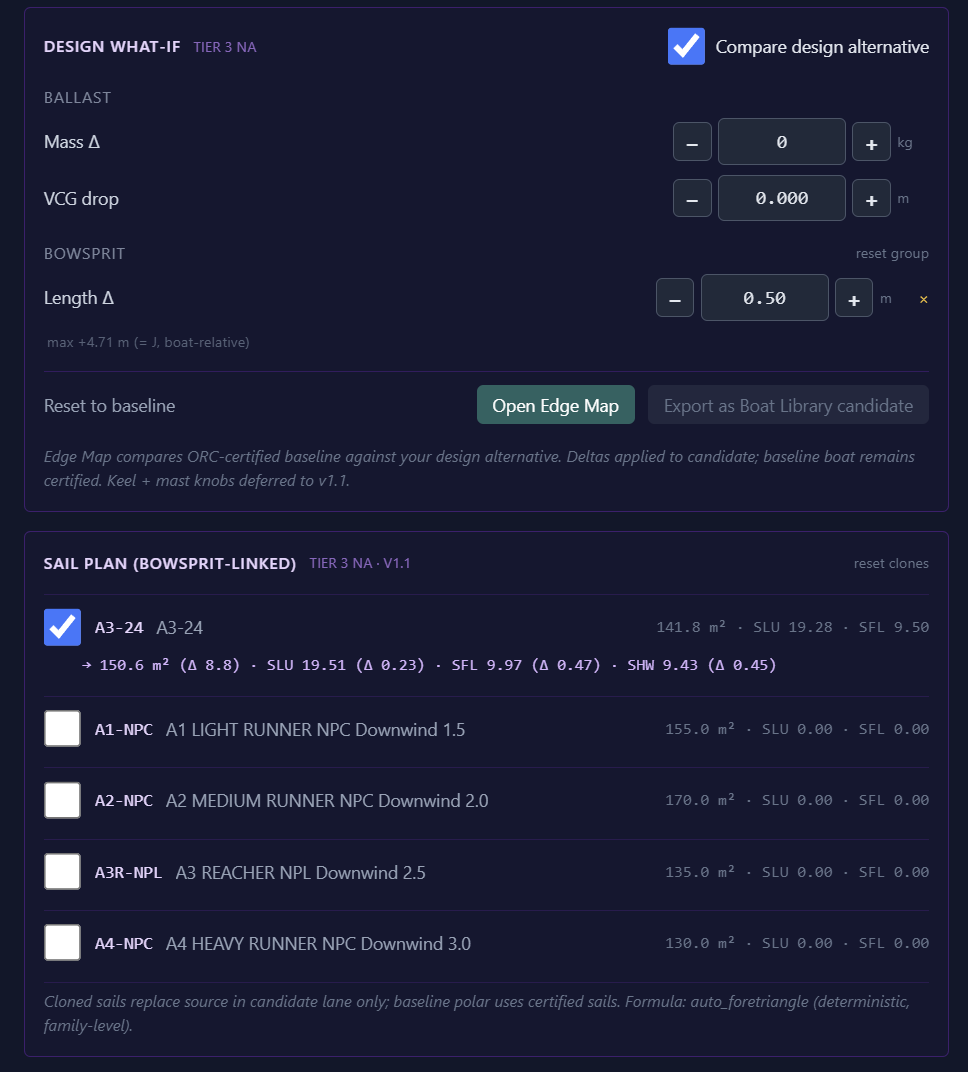
Load the client’s certificate and perturb one variable the way a design office would: extend the bowsprit. The workbench derives the sprit-flown sail candidate — labeled as the client’s what-if, never certificate data — moves the center of effort and the lead, and re-solves the candidate against the ORC-certified baseline, cell by cell. Where the sprit pays and where it costs is on one surface, gains and losses alike. It is not a complete perturbation study — the structural questions stay with the firm — and that is its use: it frames the potential benefit of the complete study for the client before the work begins.

The bowsprit, as a perturbation study

The placement and benchmark study — FleetEdge

Place the design on the 8-archetype map (the 2026 census) and read it against the fleet: which measured population it joins, how that population has actually raced, and where the design’s departures from its cluster are intentional. The benchmark extends through the race archive — weather-conditioned, archetype-conditioned.

The fleet archetypes Design Benchmarks
SailEdge Design What-If panel — ballast mass and VCG deltas, a bowsprit length delta, and the bowsprit-linked sail plan showing the derived candidate's scaled area, luff, foot, and half-width

Proof

The Farr Design partnership

Farr Design — the naval architecture firm behind some of the most successful offshore racing programs of the past four decades — has adopted SailrScience physics across their consulting workflow. Their client surface now carries the Powered by sailr.science™ co-brand.

Read the case study

From the product side

The fleet analytics surface naval architects use directly is FleetEdge™ by SailrScience — the portfolio’s fleet-scale workbench. The per-boat workbench paired with it is SailEdge™ by SailrScience. The institutional NA lane on FleetEdge surfaces the archetype map, dimension decomposition, and race-cohort filtering that the services tier extends with custom analysis.

FleetEdge analytics for NA workflows · The fleet archetypes · SailEdge boat tuning — the design what-if

Discuss your project

Tell us what design question you’re trying to answer. We respond with the data scope and engagement shape we’d propose.