Every sail. Every angle. Every delta.

Your edge.
Quantified.

SailEdge™ by SailrScience turns your ORC certificate into a digital twin powered by a VPP-class force-balance engine — 850,000+ performance predictions, per-sail attribution, and whole-boat explainability across every sail, every wind speed, every angle. Your boat. Your data. Your decisions.

For racers, sailmakers, and naval architects.

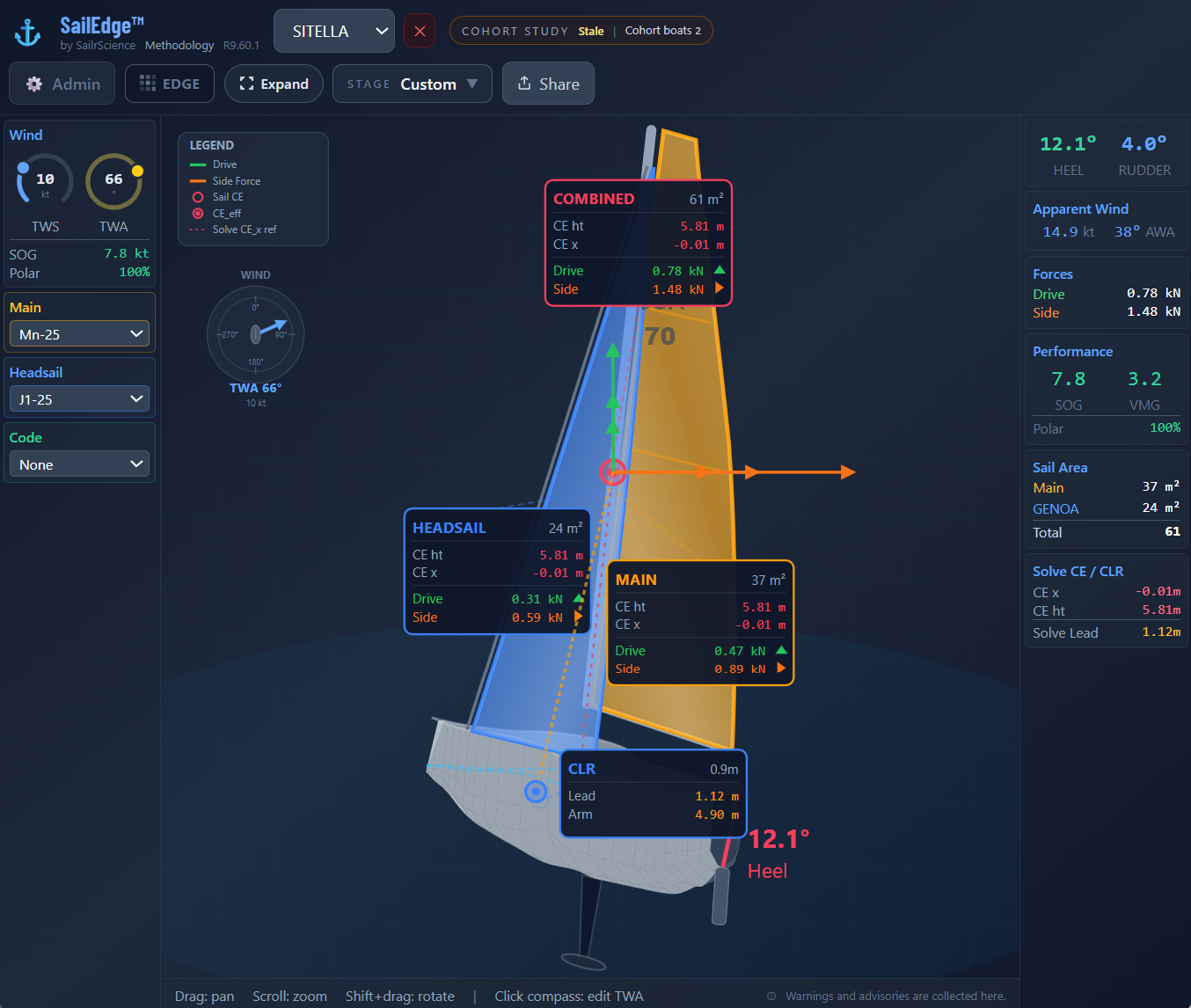
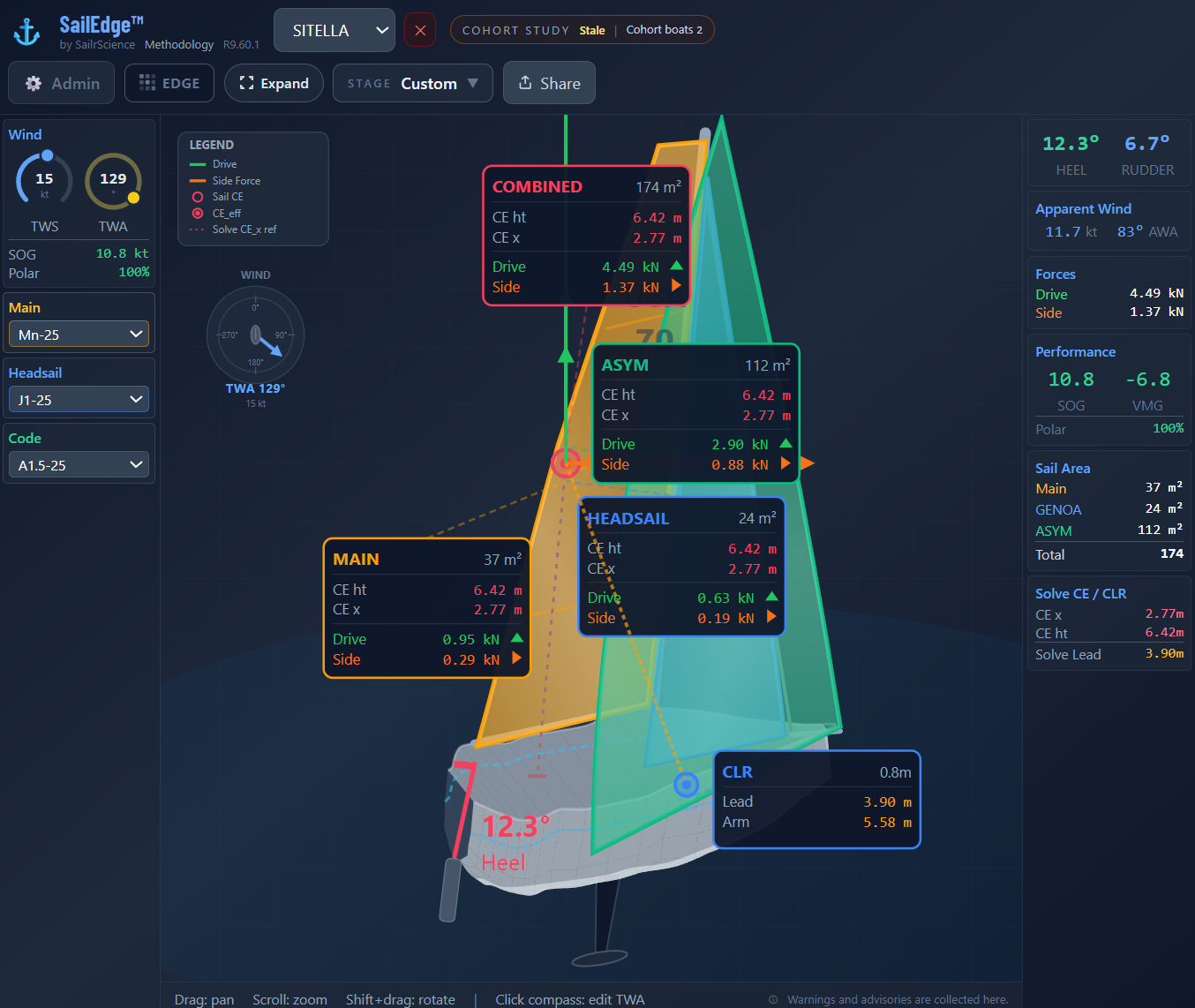
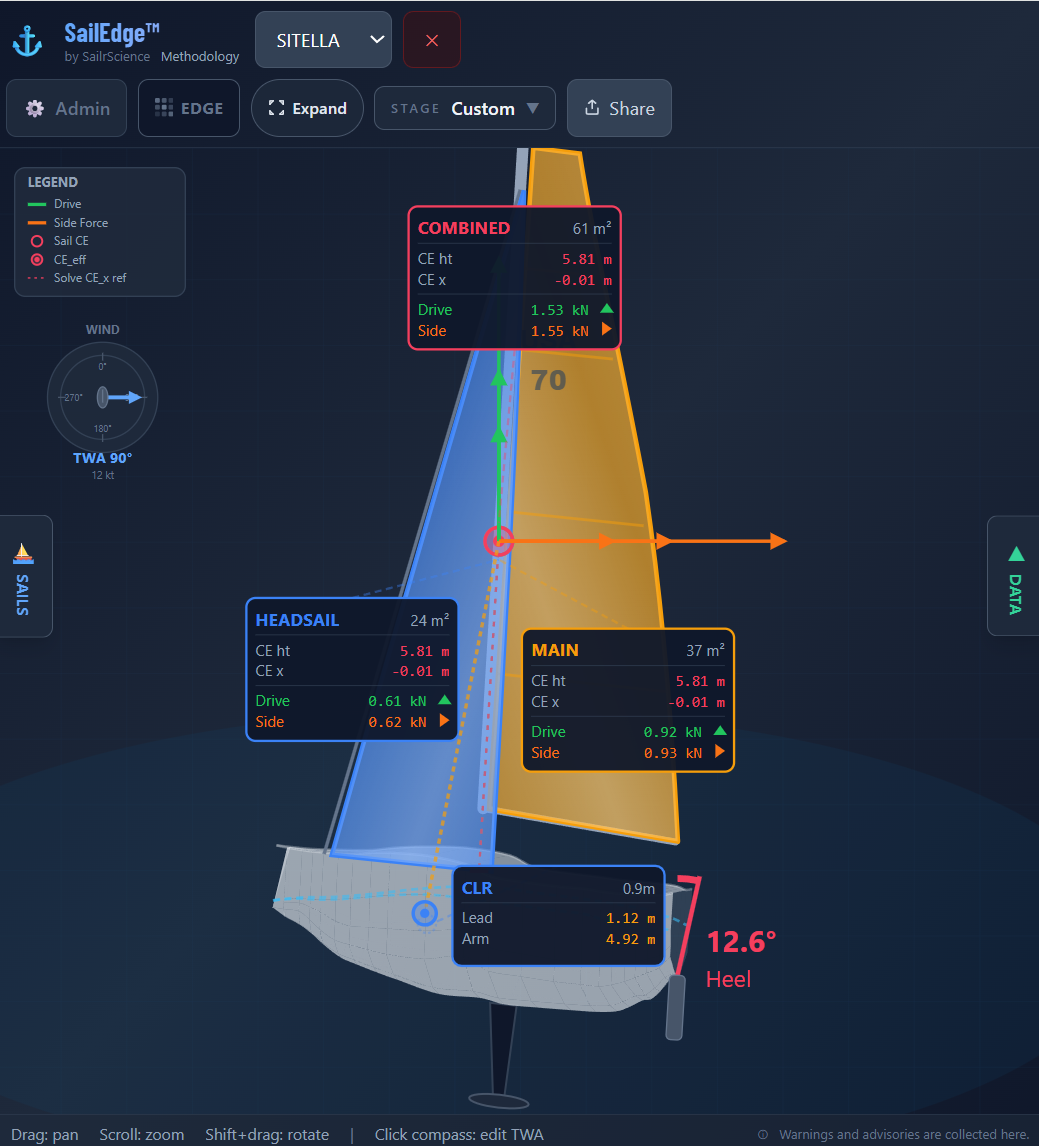
SailEdge Digital Twin — Sitella (Cape 31) beam reach TWA 86° TWS 15 kt, Main + Headsail (61 m²), Drive 2.39 kN, Side 2.35 kN, 19.1° heel, per-sail CE cards and force vectors SailEdge Digital Twin — Sitella (Cape 31) close reach TWA 66° TWS 10 kt, Main + Headsail, Side 1.48 kN dominates Drive 0.78 kN, 12.1° heel SailEdge Digital Twin — Sitella (Cape 31) broad reach TWA 128° TWS 15 kt, Main + Headsail + A2-25 (177 m²), Drive 4.71 kN, 10.7 kt SOG, 13.5° heel, Cohort Study mode

907+
Physics formulas
850K+
Predictions per boat
ORC 2025 & 2026
Compliant — tested against hundreds of recent certificates
VPP-class
Force-balance at every cell

In active evaluation by leading US sail lofts and international performance analysts.


What’s under the hood

The engine between your certificate and your edge.

Your ORC certificate is the anchor. Every delta is measured from there.

The runtime hydro layer now carries a boat-integrated Delft Series Hydro backbone, then resolves appendage resistance, heel influence, sideforce/leeway, rudder interaction, and approved wave resistance where the boat data supports it. Drive that doesn’t survive the full force balance doesn’t reach the speed prediction.

CE is computed from actual sail planform geometry — not rig ratios. Each sail carries its own force decomposition: drive, side force, heel moment. Blanketing is real — the model accounts for it. Fly two sails and the engine force-weights them into combined balance.

The 3D view renders it live. Force vectors. CE markers. CLR. Heel. A physics instrument, not a picture of a boat.

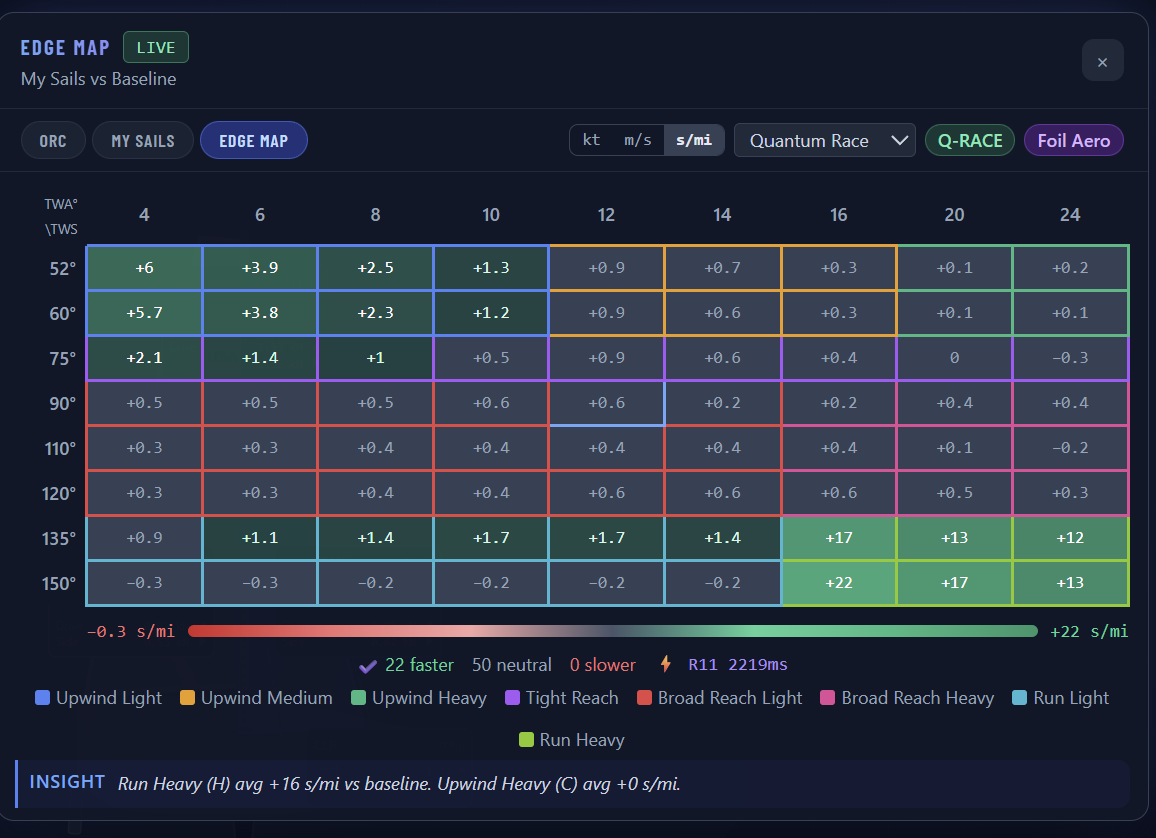
The Edge Map distills it into one grid. Green where you’re faster. Red where you’re not. Tap a cell and the panel carries both per-sail attribution and whole-boat outcome, so a gain in drive can be weighed against heel, rudder demand, drag, wave lane status, and balance shift.

Built on ORC certificate data. Not affiliated with ORC. Not a rating predictor.
See the full physics → For racers → For sailmakers → For naval architects →
Edge Map — Sitella (Cape 31), Main vs Mn-25 in seconds per mile. 22 faster, 50 neutral, 0 slower. R11 physics with regime color coding and INSIGHT bar.
Sitella (Cape 31) — Main vs Mn-25 in seconds per mile. Regime color coding, INSIGHT bar, and results toggle between kt, m/s, and s/mi.

How it works

Upload your certificate. See your edge.

Start with your ORC certificate. SailEdge™ extracts your hull, rig, and sail inventory, builds your Digital Twin, and delivers your first Edge Map. Add cut sheets when you’re ready to go deeper.

Step 1

Upload

Your ORC certificate
and sail cut sheets
(if you have them)

Step 2

SailEdge Computes

Force-balance across every cell —
hull resistance, heel equilibrium,
per-sail aerodynamics

Step 3

You Explore

Forces, balance, heel, and speed
deltas across every condition


What SailEdge does

Three audiences. One engine.

For Racers

Confirm what you have. Explore what your crew changes. Walk into the loft with data.

Explore →
🗺

Edge Map

Upload your ORC certificate, pick a sail or change your crew, and see the delta. Green where you’re faster. Red where you’re not. Your edge, quantified.

Explore →
📱

Digital Twin

Your boat, your sails, your rig — 200+ parameters driving a full force-balance computation. Your entire sail plan, modeled and in your pocket. Select from Delft hull references with visible cross sections. Tune stability per hull family.

Explore →

For Sailmakers

Your design team calibrates the model. Every office in the network sells with it. One calibration, any boat, quantified proof.

Explore →
🧵

Loft Workflow

Calibrate once against on-water data. Save the tuning profile. Any rep loads a customer’s certificate and the design team’s physics travel with it.

Explore →
🔧

Expert Mode

Sail tuning for lofts. Hull tuning for architects. The physics scale with the conversation — same engine, different depth.

Explore →
📐

NA Workflow

Validate the hull side of the force balance. Tune resistance, heel, and stability to match your platform data. Save it as the calibration every sailmaker builds on.

Explore →

The Physics

VPP-class force-balance at every point in the wind matrix. Hull resistance, heel equilibrium, per-sail aerodynamics — 907 formulas, fully server-side.

Explore →
🔬

Cell Anatomy

Every cell in the Edge Map contains a complete force-balance solution. Tap one. See what drove the delta — which sail, which force, which constraint.

Explore →
📜

ORC & SailrScience

Built on ORC, not around it. Certificate data is preserved exactly as issued. Every delta is measured from there.

Explore →
📖

Methodology

Three layers of physics documentation — from the core equations anyone can audit, to the aero model that sail lofts calibrate, to the hull response that naval architects validate.

Explore →

About

Built in Annapolis by a sailor who needed it. This started on a boat, not in a lab.

Explore →

See It Live

Your certificate. Our engine. Your edge.

SailEdge is live. Pick a boat, fly any sail, and see 850,000+ physics-backed predictions — forces, balance, heel, and speed deltas across every condition.

Explore Your Edge Talk to Us →