One question per study.
One answer per cell.
A Sail Study isolates a single decision — one sail changed,
everything else held constant — and shows the result across the
wind range. No noise. No confounding variables. Just the answer to
the question you’re actually asking.
Try a Sail Study
← Back to Edge Map
Photo: Don Ramey Logan / Wikimedia Commons
The Concept
Same boat. Same wind. One variable.
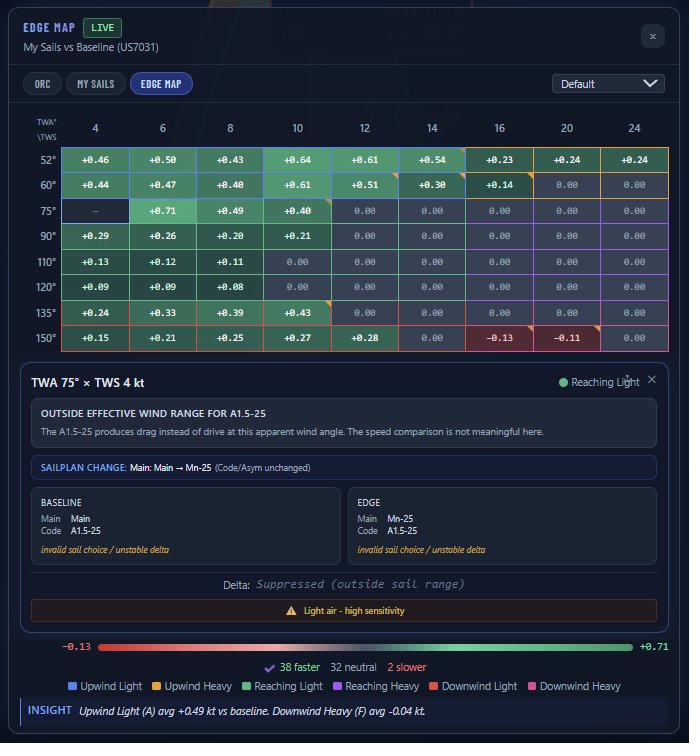
A full Edge Map compares your entire inventory against the ORC baseline.
That’s powerful — but sometimes the question is simpler:
“What happens if I swap just this one sail?”
A Sail Study narrows the focus. It defines a wind regime — a specific
range of wind angles and speeds — and isolates one variable: the sail
you’re evaluating. Everything outside the study regime shows zero delta.
Everything inside shows the impact of that one change, measured against
your baseline.
The result is a focused answer. Not “how does my whole inventory
compare” but “does this specific sail help, in these specific
conditions, on my boat.”
Going deeper?
Sail lofts run pre-purchase comparisons and campaign presets for their clients.
Naval architects use study outputs to augment ORC cert reviews and evaluate
appendage configurations. Those studies live in the workflow pages built for
each audience.
Loft Workflow →
·
NA Workflow →
Your Polar, Your Grid
Study boundaries come from your certificate.
Every Sail Study aligns its wind regime to the TWA and TWS grid points on
your ORC polar. No arbitrary bins. No generic “light / medium /
heavy” buckets. The study boundaries match the exact conditions your
certificate defines, so the results map directly to the performance data
your rating already provides.
This means a study on one boat isn’t a copy-paste from another. The
wind regime is specific to your hull, your rig, and your certificate.
Get Started
Pick a question. See the answer.
SailEdge™ comes with pre-loaded Sail Studies covering the questions racing sailors ask most — upwind headsail crossovers, Code Zero evaluation, kite selection, staysail under kite. Pick one from the dropdown, and the study runs on your boat with your ORC polar. One click. One answer.
Partner sail lofts can design their own regime packs — curated sets of Sail Studies built around the sails they make and the conditions their fleet sails in. When a loft publishes a regime pack, every customer on that loft’s roster can load it with one click. The studies run on each boat’s own ORC polar, so the results are specific even when the study design is shared. See Loft Workflow for how it works.
Want something specific? Build your own study — choose your baseline sails, your test sails, and define the wind regime. For custom analysis beyond what the builder offers, get in touch.