Three levels of depth.
One transparent model.

SailEdge™ by SailrScience’s sail model is built in three layers — on top of the same ORC-anchored boat runtime built on a DSH calm-water backbone with bounded follow-on lanes. The methodology is open, the equations are documented, and the outputs are traceable.

Explore Your Edge Pick a layer →
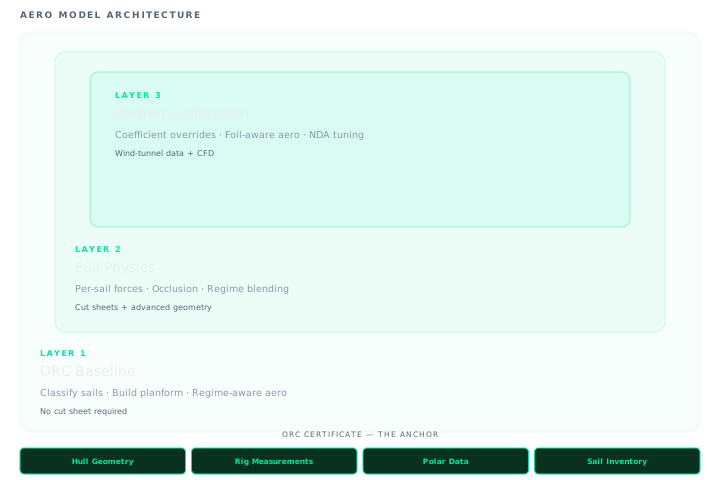
SailEdge aero model architecture: three nested layers built on the ORC certificate foundation

907 formulas. Seven-step pipeline. Every assumption inspectable.

SailrScience computes per-sail aerodynamic forces, resolves center of effort by geometric centroid, blends across six wind regimes, and solves against a live boat runtime built on the DSH calm-water backbone with bounded follow-on lanes — all anchored to your ORC certificate. Nothing is hidden. Click any cell in the Edge Map and trace the delta back to coefficients, depower, provenance, and whole-boat outcome.

Want the deep dive? Keep scrolling. Want to see it work? Explore Your Edge.


Choose Your Depth

One model. Three levels of detail.

How the model works

You have an ORC certificate and basic sail measurements. The model classifies your sails, builds a planform, and runs regime-aware aero to produce an Edge Map. Directionally correct. Explainable. No cut sheet required.

Read Layer 1 →

Full physics pipeline

You have cut sheets and advanced sail geometry. The model uses stacked-trapezoid planforms, per-sail force decomposition, occlusion modeling, and continuous regime blending. Click any Edge Map cell to see CL, CD, drive, side force, heel, rudder, and whole-boat outcome detail.

Read Layer 2 →

Partner-level methodology

Your loft has wind-tunnel data, CFD results, or proprietary sail coefficients. The model accepts explicit coefficient overrides, foil-aware aero adjustments, and campaign-based tuning profiles — all protected server-side under NDA.

Read Layer 3 →

Every layer starts from the same anchor.

Regardless of layer, every computation starts from the same anchor: your ORC certificate, its certified polar baseline, and the same boat runtime built on the DSH calm-water backbone with bounded follow-on lanes. Every delta is measured from that certified baseline. Every output carries provenance tags showing where each value came from. The model is stateless and deterministic — same inputs, same outputs, every time.

What we publish: equations, pipeline, assumptions, provenance. What we don’t: exact tuning coefficients, calibration data, or protected partner-specific model parameters. The methodology is open. The competitive advantage of our partners stays private.

The certificate supplies four categories of binding input: hull geometry, rig measurements, polar performance data, and sail inventory dimensions. These are the contract — immutable inputs that anchor every computation. Crew weight is a separate analysis dimension — unlocked at Tier 2 — and handled as a bounded what-if, not a certificate override.
See it on your boat.

Explore Your Edge Talk to Us →