Layer 3 is designed for sailmakers and elite race programs. It extends planform fidelity into foil-aware behavior (squaretop vs pinhead, batten support, shape-holding), and introduces partner-private tuning sets that can be saved and loaded under NDA.
Loft engineers access Layer 3 through Expert Mode, and their named tuning profiles persist in the Sail Tuning Library for distribution to every customer on the roster.
Attribute more drive to a better foil — without turning into CFD.
Top lofts win because they control foil shape: luff curve, seam shaping, batten support, and cloth choices
that hold shape across a wider wind range. Layer 3 is built to reflect that reality in a bounded, product-friendly way:
better foils produce measurable Edge Map improvements where they should, especially in upwind regimes.
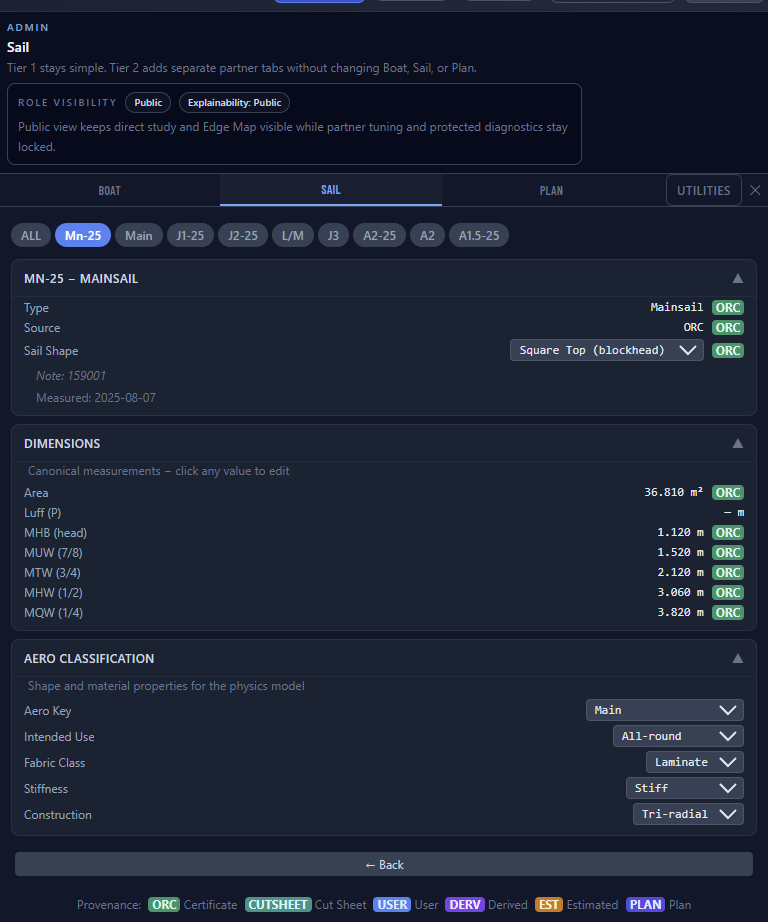
Sail-level aero classification — Fabric Class, Stiffness, and Construction properties that drive the Layer 3 loft model. ORC dimensions with provenance badges.What Layer 3 adds beyond Layer 2
Foil-aware upwind aero: translate planform shape into bounded upwind efficiency modifiers with smooth fade-out toward reaching/downwind.
Stiffness/cloth factors: represent “shape-holding” and performance retention (especially at the low and high ends of the wind range).
Partner campaign profiles: a loft can define campaign presets (bounds + defaults) that reflect their product line.
Explainability hardening: cell click-through can show which modifiers were applied and which profile supplied them (without exposing raw proprietary tables).
Loft Workflow
Edge Map as an iterative design loop
Lofts typically iterate: design → build → test → refine. Layer 3 makes that workflow visible in the Edge Map:
not “one number,” but a complete wind-matrix signature of the design change.
1
Baseline
ORC cert + current inventory
Establish baseline performance with the boat’s certificate polar and existing sails. This anchors discussion
in certified reality.
2
Prototype
New design iteration
Define a new main (squaretop vs pinhead) or headsail/spinnaker with planform and foil descriptors.
Keep the comparison controlled: same boat, same wind, known baseline.
3
Tune (partner private)
Apply campaign profile
Apply loft-specific tuning sets and bounds that encode how that loft expects its product line to behave.
These values are treated as partner IP.
4
Evaluate
Edge Map signature
Gains appear where intended (for example, a squaretop main improves upwind drive without paying an unrealistic
stability penalty). Losses and tradeoffs show up clearly in non-winning regimes.
Partner IP + Security
Save/load partner-private profiles without leaking coefficients.
Layer 3 introduces an explicit partner confidentiality model:
the method remains inspectable, but partner-specific tuning values are private.
This enables a sailmaker to use SailEdge™ by SailrScience as a customer-facing decision tool while protecting their design IP.
Partner-private tuning on the Sail tab
Each sail can reference a tuning set (campaign preset) that belongs to a partner.
Example: “Loft campaign v1” could apply loft-intended defaults for foil efficiency, stall characteristics,
and shape-holding behavior within bounded limits.
Partner-private coefficient profiles on the Model tab
Global model bounds and defaults can be saved/loaded as partner model profiles.
This allows each loft to run their own “house model” without hard-coding coefficients into the public UI.
Explainability without leaking IP
The Edge Map click-through can disclose which modifiers were applied and their directionality (e.g., “upwind foil efficiency +6%”),
while withholding raw coefficient tables and proprietary mappings. This keeps results defensible for racers while protecting loft IP.
The Edge Map. Per-sail forces and CE. The performance delta in knots. Provenance
tags showing where each value came from — but not the tuning coefficients
behind them.
The physics stays ours. The client relationship stays yours.