Your Sails. Your Calibration. Our Engine.
SailEdge™ by SailrScience lets your design engineer calibrate the sail side once
on top of a live boat model built on a DSH-backed calm-water backbone with bounded
follow-on lanes. Every rep distributes that calibration to every customer — with
Edge Maps tuned to your sails, not generic defaults. Over 14,000 ORC certificates were issued in 2025 — each one a potential client with complete hull, rig, and sail data already on file.
Explore Your Edge
Talk to Us →
Calibration
Your engineer tunes the model. The loft owns the result.
Your senior designer or design engineer opens Expert Mode and calibrates
how SailEdge represents your sails. Bounded per-sail tuning, foil-aware
geometry, sailmaker overlay profiles, and regime trim packages all live as
named assets in your Sail Tuning Library.
Each profile maps to a specific sail design. Campaign presets group
profiles for a regatta or season — one click loads the whole configuration.
The calibration compounds over time. Every iteration builds on the last.
Cut sheet in. Design delta out. Your sail measurements — luff, leech, foot, LP,
roach profile — combine with the boat’s ORC twin and live hydro response built on
the DSH calm-water backbone with bounded follow-on lanes to position each sail’s CE
precisely. The result is a governed study state that carries your design intent as a
portable performance contract.
See the loft workflow →
Explore Expert Mode →
Distribution
Calibrate once. Distribute to thirty customers.
Your sales rep doesn’t need to understand the raw tuning math. They
select the customer’s boat, load the loft-calibrated profile, and run
the Edge Map. The results reflect your engineering on that boat’s live
runtime physics — not factory defaults.
Thirty customers on the same class? Same calibration. Different
sail inventories, different Edge Maps — all anchored to your tuning.
The Sail Tuning Library scales your expertise without scaling your headcount.
Regime packs are curated Sail Studies
built around your sails and your fleet’s conditions. Distribute one pack to 30 customers.
Each customer runs the study on their own boat.
See the distribution workflow →
Customer Impact
Your sails arrive with proof they’re faster.
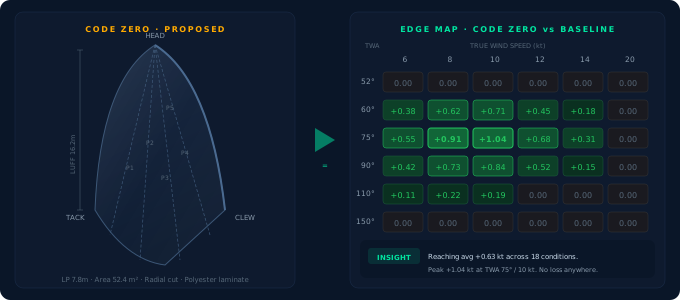
At quote phase, your client sees a loft-tuned Edge Map — not a generic
brochure claim. The partner sail asset ships with the analysis attached:
where the new sail gains, by how much, in which conditions, and what the
whole boat paid for that gain.
The Edge Map becomes part of the purchase experience. Clients share it
with their crew, study it before the regatta, and come back next season
asking “where’s my next tenth?” That’s a revenue
conversation you own.
When a customer’s new sail doesn’t deliver the expected edge downwind but
the upwind picture lights up green, crew weight is often the story. The RM supplement
separates the sail’s contribution from the crew’s — visible to your
customer at Tier 1, no custom engagement needed.
See how crew weight changes the edge →
Hull selection now starts with a better reference. When the hull family is right
before sail tuning begins, the edge map delta is more trustworthy from the first study.
Your tuning stays yours. The Sail Tuning Library persists
server-side — encrypted, partner-isolated, and NDA-ready. Your clients
see Edge Map results, whole-boat outcome, and governed study artifacts —
not the protected tuning or implementation that produced them. Every iteration
compounds. The library is your persistent engineering asset inside SailEdge.
Fleet Intelligence
You calibrate sails one boat at a time. FleetEdge™ shows you the fleet.
FleetEdge ranks 1,000+ ORC-rated boats by sail performance, hull efficiency,
and design family. See which boats carry the biggest gaps — by event,
by class, by nation. Eleven performance archetypes show where fleets cluster
and where opportunities sit.
Market intelligence built on physics, not guesswork. The same engine that powers
your loft calibration now powers fleet-wide analytics.
Explore Fleet Analytics in FleetEdge →