From ORC Certificate to Edge Map in Under a Minute
Confirm what you have. Find where you’re slow. Walk into the loft with data and a whole-boat readout.
Drop your ORC certificate. Hull, rig, full sail inventory — extracted in seconds.
Check your inventory against reality. These are the sails you’re racing with — this is the baseline.
The Edge Map shows the shape of your sail plan’s strengths — and the conditions where you’re leaving speed on the table.
You know where you’re slow and in what conditions. Your loft fills the gap. The conversation starts from shared data.
All you need is your ORC certificate — the HTML file from orc.org. Drop it in, and SailEdge™ builds your Digital Twin in seconds. Your hull, your rig, your full sail inventory — extracted directly from the certificate. Nothing to enter by hand.
Upload your ORCi certificate and SailEdge™ builds three things in under a minute: your Digital Twin, your performance polar, and your full sail inventory with dimensions already loaded. No data entry. No assumptions. Your boat, as ORC measured it.
Don’t have an ORC certificate? Get yours at orc.org →
Your Digital Twin loads with every sail on the certificate. Check the inventory against what you actually race with. Main and jib dimensions, headsail options, spinnakers — confirm the list matches reality. This is the baseline the model will work from.
On the Boat tab, select from Delft Series hull references that match your boat’s stability profile. See the hull shape with cross sections before you trust the numbers. Learn more about hull selection →
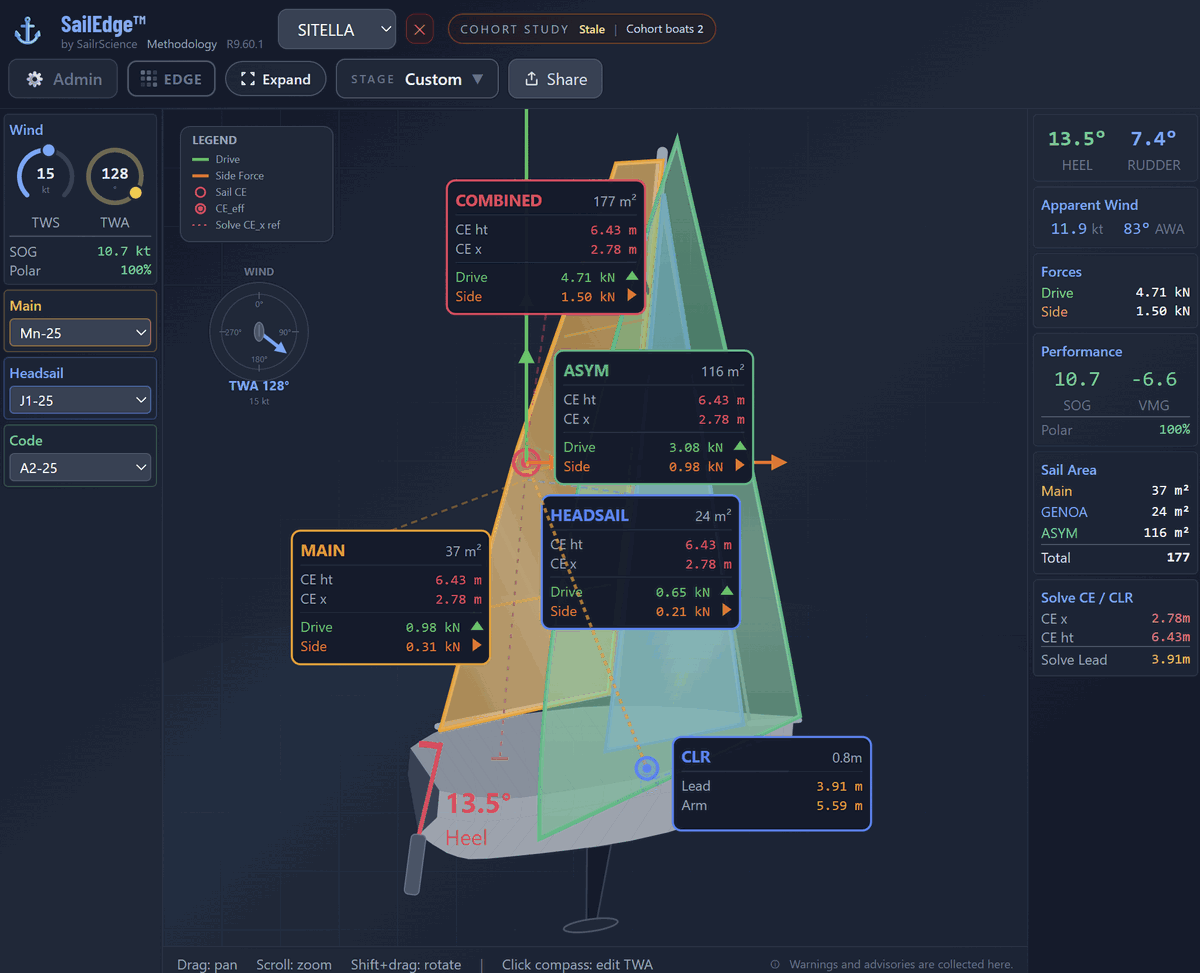
Pick conditions you know. A reaching angle you sail every Wednesday night. The upwind leg in 12 knots where you always feel slow. Open the 3D boat rendering and the performance cards for that cell.
Reality check: does the speed match your instruments? Does the heel and rudder picture look right? Is the headsail doing the work where you’d expect? The whole-boat outcome helps you see whether the gain is clean or paid back in drag, heel, or control load. If the model matches your experience, you’ll trust what it shows you next.
Want to know what’s behind those cards? Anatomy of an Edge →
The Edge Map lays out your sail plan across the full wind matrix. Look for patterns. Strong reaching but weak upwind? Nothing between 60 and 90 degrees? Competitive downwind but losing to the fleet on close fetches?
The map shows the shape of your sail plan’s strengths — and the gaps. Tap the cells that matter and read the force picture, heel, and whole-boat outcome before you spend money.
Want to isolate a single question? Sail Studies let you compare one sail, one configuration, one decision — across every wind condition. Pick from pre-loaded studies or build your own.
Check one box, change the crew weight, and the map recomputes. Lighter crew and you gain on reaches but pay upwind. Heavier crew and the upwind picture changes — more righting moment, more stability.
No Expert Mode. No custom engagement. One checkbox, and you see where crew weight moves your edge.
Go deeper →You’re slow from 60 to 90 degrees in 10–14 knots. Now you know. The question becomes: what sail fills that gap?
Specific conditions. Backed by data. Not a hunch at the bar — a quantified gap you can hand to your sailmaker and say “this is what I need.”
You know the conditions and the gap. If your sailmaker is a SailEdge partner, they can load your boat, apply their protected tuning on top of the same boat model built on a DSH-backed calm-water backbone with bounded follow-on lanes, and show you what their sail does on your hull in those conditions.
The conversation starts from a shared view of the problem, not a product pitch. And if crew weight is part of the picture, both you and your loft see the same RM supplement — no guessing.
Don’t know if your loft is a partner? Ask them. Or talk to us →
Save your boat and your studies. Come back after the purchase, update with real sail measurements, and run the study again. The gap you identified — did the new sail fill it?
Your SailEdge data is yours. Export it, revisit it next season, or share it with your sailmaker to start the next conversation.
Upload your ORC certificate. Confirm your sails. Change your crew. Find your gap.
Explore Your Edge How does it work? →