Every sail. Every condition.
The winning configuration.
Your wardrobe has 7 sails. At any wind speed and angle, one configuration is fastest. The Optimal Map finds it — across your entire polar grid, with the physics to prove why. No product in sailing has computed this before.
Explore Your Edge See the Edge Map →Your best sailplan. Optimized.
Up to 18.4 million physics calculations depending on the size of your sail wardrobe — across every sail, every wind speed, and every angle — to find the winning configuration at each condition and the exact crossover points between them. This turns a conversation with your sailmaker into a strategic wardrobe decision when planning seasonal upgrades. It’s also your strategic planner for the upcoming race — when the forecast favors a particular wind regime, you want to know you have the right sails packed and the crossover points committed to memory.

The Crossover
Where you change sails is where races are won
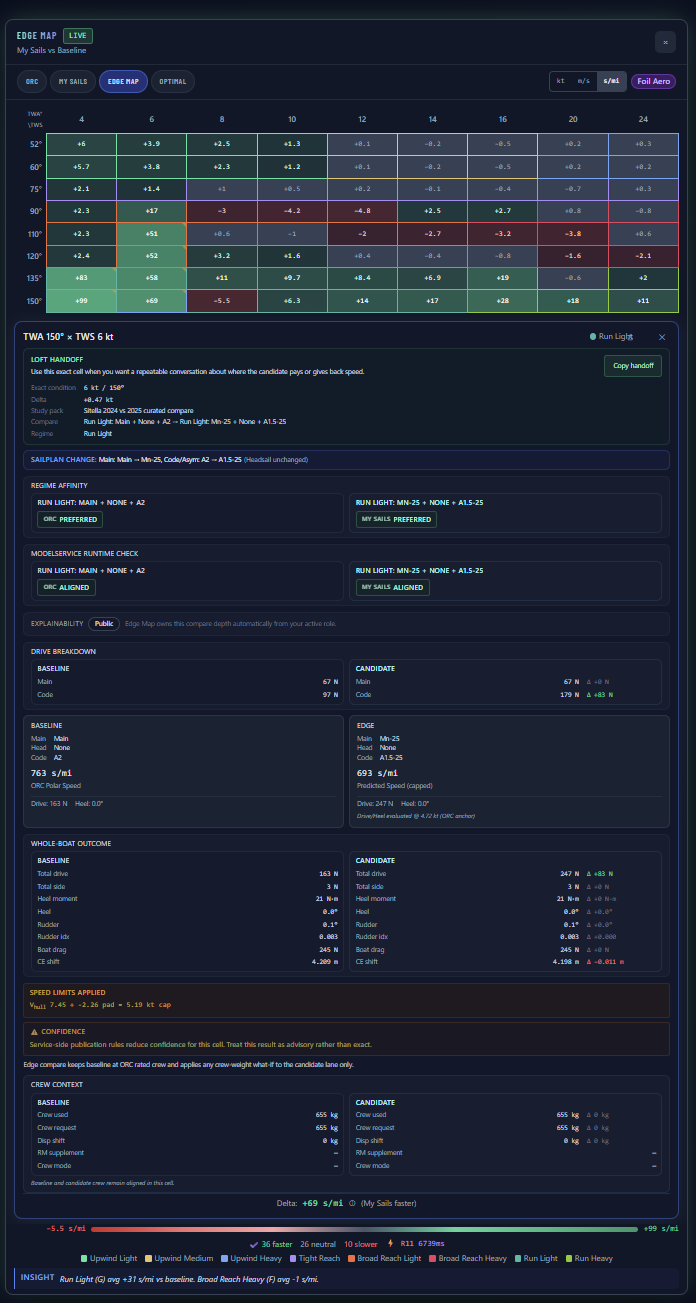
The Edge Map compares two configurations — a purchase decision you make once a season. The Optimal Map ranks your entire wardrobe and finds the crossover zones — a race-day decision you make 10 times per regatta.
At 10 knots and 135 degrees, your light-air kite beats the reaching kite by 0.18 knots. That’s 3 seconds per mile. Over a 6-mile downwind leg, that’s 18 seconds. Now you know.
The crossover your crew argues about? It’s computed.
Per-Sail Intelligence
Your sails aren’t interchangeable. Neither is the physics.
Your light-air kite fills in a whisper and thrives going deep. Your reaching kite needs breeze but crushes it at beam reach. They look similar on a shelf. On the water, they’re different sails. The engine knows.
Fills early. Peaks deep.
Lighter cloth, fuller shape. Flies when others can’t. Projects more area to the wind at deep angles.
Needs wind. Thrives at reach.
Stiffer fabric, flatter cut. Holds shape under load. Comes alive when the apparent wind builds.
Not an algorithm picking favorites. Physics differentiating designs.
Your Selection
Racing with two kites this weekend? Check two.
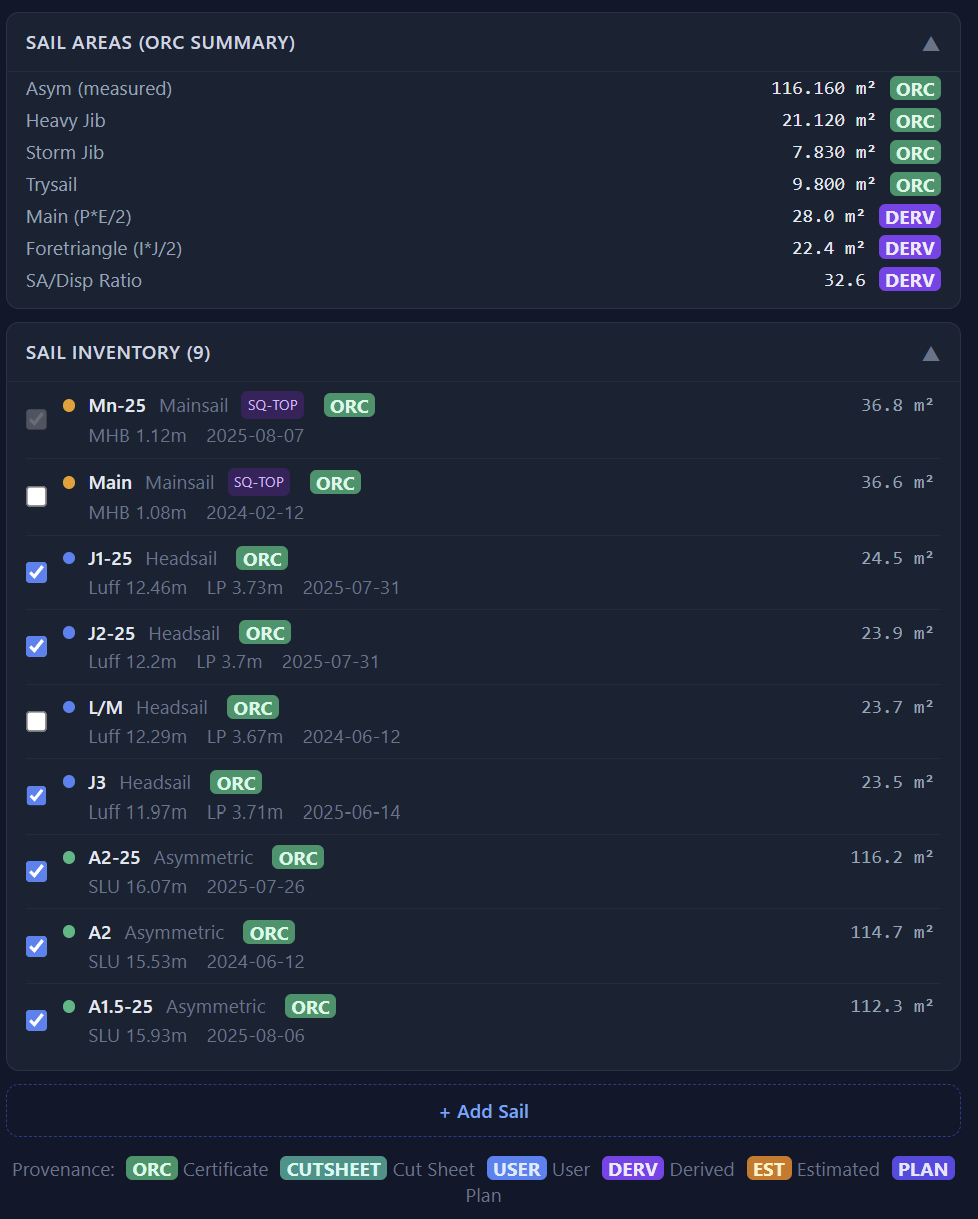
Every sail in your inventory has a checkbox. Check the sails you’re considering. Uncheck the ones staying in the bag. The Optimal Map recomputes with your selection — your actual options, not the full wardrobe.
Before the race: which kite should I pack? After the race: was my sail change at the right wind speed? The Optimal Map answers both.
Race Prep
The briefing happens before you leave the dock
Wind forecast says 8–12 from the south. Your Optimal Map says start with the reaching kite, switch to the light-air kite at the first downwind mark if wind drops below 10.
Share the crossover grid with your crew. Save it for the season file. The decision is made before the warning signal.
Works on your phone. Portrait and landscape. The full grid, on the rail.
Every audience. One grid.
Racers & Teams
Pre-race planning grounded in physics. Your crew knows which sails to fly at every angle and speed — and exactly when to switch.
Sail Makers
Show your client where each sail earns its keep — and where the next purchase fills the biggest gap in their wind envelope.
Naval Architects
Full combinatorial VPP analysis that would take days of manual computation, delivered in seconds. Present the crossover grid to your client.
ORC Leaders
Over 14,000 ORC certificates issued in 2025. Every one could seed an optimal sail plan. The certificate becomes a complete performance analysis.
Your wardrobe. Your wind.
Your winning configuration.
Race prep. Quantified.