The Physics Behind Your Edge

SailEdge™ runs a complete force-balance computation at every point in the wind matrix — drive, side force, heel equilibrium, a DSH-backed calm-water backbone with bounded follow-on lanes, resistance, depower — solved iteratively for every sail combination in every condition. This page explains what gets computed and why it matters.

Explore Your Edge Read the walkthrough →
Foundation

It Starts with the Certificate

Every SailEdge computation begins with an ORC certificate — your hull lines, rig dimensions, sail inventory, displacement, and the complete polar table produced by the official ORC VPP. That polar is the immutable floor. SailEdge never overrides it, never adjusts it, never second-guesses it.

The certificate defines what the boat can do in ideal conditions with the rated sail plan. Everything SailEdge adds is built on top of that baseline. Built on ORC, not around it.


Wind Model

From True Wind to Apparent Wind

ORC reports true wind speed at a 10-meter reference height. SailEdge takes that true wind vector and converts it to apparent wind at the sail plan — accounting for boat speed, heel angle, and leeway. The apparent wind speed and angle that arrive at each sail drive everything downstream: the forces, the loads, the balance.

Get the apparent wind wrong and every force calculation that follows is wrong with it. This conversion is the first thing the solver does and the last thing it checks.


Aero Forces

Lift, Drag, and Everything in Between

Each sail in the plan — main, jib, genoa, spinnaker, code zero — gets its own force decomposition. Lift and drag coefficients are computed from the sail’s geometry and the apparent wind angle. Those coefficients produce a drive force (forward) and a side force (heeling) for every sail independently.

Sails don’t operate in isolation. When a headsail sits in the main’s wind shadow at tight angles, the model accounts for blanketing — the reduction in effective wind that the downstream sail actually sees. The shape of each foil matters too: aspect ratio, overlap, roach. Different sail shapes produce different force profiles at the same wind angle.

At the professional tier, loft-specific sail shapes feed directly into these coefficients. The generic geometry is replaced with measured cut-sheet data.
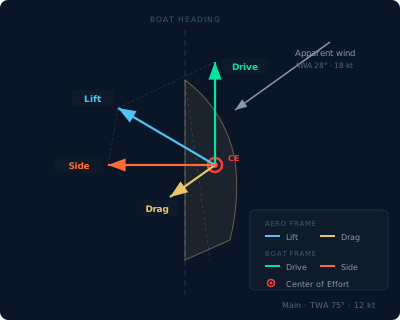
Force decomposition diagram showing sail planform with lift, drag, drive, and side force vectors from center of effort — aero and boat reference frames

Hydro Forces

The Boat Pushes Back

Aero forces drive the boat forward. Hydrodynamic forces resist that motion. In the current runtime, SailEdge uses a boat-integrated Delft Series Hydro backbone grounded in ORC certificate geometry and approved boat-carried hydro fields. Upright hull resistance, heel influence, appendage resistance, sideforce/leeway, rudder interaction, and approved wave resistance are resolved as named hydro lanes where the boat data supports them.

Your boat’s resistance profile is unique. When a lane is authoritative, the model uses your boat’s carried data and the live DSH runtime. When a lane is bounded or waiting on better input, SailEdge discloses that instead of pretending to know more than it does.


Equilibrium

Where the Forces Balance

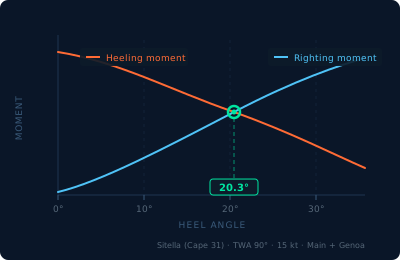
Drive force wants to push the boat forward. Side force wants to heel it over. Hull resistance wants to slow it down. The righting moment wants to stand it back up. Change the crew weight and righting moment shifts — the entire equilibrium recomputes. SailEdge solves for the heel angle where all of these forces reach equilibrium — iteratively, not by lookup.

The solver converges on a single deterministic answer for each wind condition and sail combination. Same inputs, same answer, every time. No random variation, no Monte Carlo, no stochastic noise.

Tune the righting moment for form vs ballast stability. Form-stabilized hulls need increasing RM correction at high heel angles where waterplane advantage fades.

Heel equilibrium chart showing heeling moment and righting moment curves intersecting at equilibrium angle of 20.3 degrees

Depower

When the Wind Overpowers the Rig

Real sails don’t hold their designed shape in all conditions. As wind builds past the sail’s effective range, the crew depowers — and the model does too. SailEdge applies multiple independent depower effects, each one specific to the sail type and the condition that triggers it.

Reefing the main is not the same as easing the traveler. Furling a headsail is not the same as flattening it. Each depower mechanism changes the force profile differently — reducing drive, reducing heel, or both — and SailEdge tracks each effect separately.

The result is a depower model that behaves the way sails actually behave: progressively, sail-by-sail, with each mechanism doing its own work.


Speed

From Force Balance to Boat Speed

Once the solver finds equilibrium, it produces a boat speed for that wind condition and sail combination. But that speed is not unconstrained. SailEdge applies physical limits — hull speed boundaries, stability thresholds, minimum drive requirements — and anchors the result to the ORC polar.

If the computed speed exceeds what the certificate says the boat can do under rated conditions, the model clamps. If a force balance produces an unstable solution, the model flags it. Every constraint is attributed — you can see what limited the result and why.

The certificate is the contract. SailEdge computes deltas from that contract, not replacements for it.


Output

Every Cell Tells the Full Story

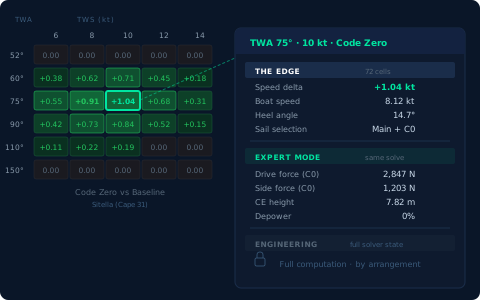
The Edge Map is the output surface. Each cell is one wind condition (TWA and TWS), one sail combination, one complete force-balance solve. The color encodes the speed delta. Tap a cell and the detail card opens.

What you see in that card depends on your tier — the decision layer shows the answer, the diagnosis layer shows the forces, the full computation shows everything. Three levels of depth. The physics underneath is always the same.

See what’s inside a cell →

Edge Map grid with selected cell highlighting Code Zero advantage of +1.04 kt, connected to three-tier detail card showing Edge, Expert Mode, and Engineering data layers

See It on Your Boat

Upload your ORC certificate. The physics runs on your hull, your sails, your conditions.

Explore Your Edge Anatomy of a cell →