CE isn't a single number — it's a position in space
Most references to Center of Effort treat it as a point on a sail plan drawing.
SailrScience computes it as a three-dimensional position that moves with every
change in wind, sail selection, reef state, and heel angle.
CEx
Fore—Aft Position
How far forward or aft CE sits along the deck.
This is the axis that drives weather helm. Move CE forward
and the boat wants to bear away. Move it aft and you get helm pressure.
"Is my genoa pulling CE too far forward at this angle?"
CEht
Height Above Deck
How high CE sits above the waterline. Higher CE means more
heeling moment for the same force. Reefing lowers CE. A staysail
keeps CE low. This is the axis that governs comfort and control.
"How much does reefing the main actually lower CE?"
CEy
Lateral Offset
How far CE moves to leeward under heel. As the boat heels,
CE shifts laterally — increasing the moment arm and changing
the balance. This is the axis most sailors never think about.
"At 15° of heel, where has CE actually gone?"
How We Compute CE
Your sail’s real shape. Not a lookup table.
Most models place CE from generic rig ratios. SailrScience uses centroid
geometry — the measured planform of each sail defines where force actually acts.
Tack, head, clew, plus roach profile when available.
A high-roach main puts CE higher and further aft. A deep-LP genoa moves it forward.
These aren’t assumptions — they’re geometry, traced back to sailmaker
cut-sheet measurements. When you change sails in the model, CE moves for the
right reasons.
TPS, SPL, and IG are captured directly from your ORCi certificate — the exact
measurements that fix where each sail can fly. Forestay attachment, spinnaker pole
length, inner forestay position — these define the geometry of your sail plan.
SailrScience reads them, not assumes them.
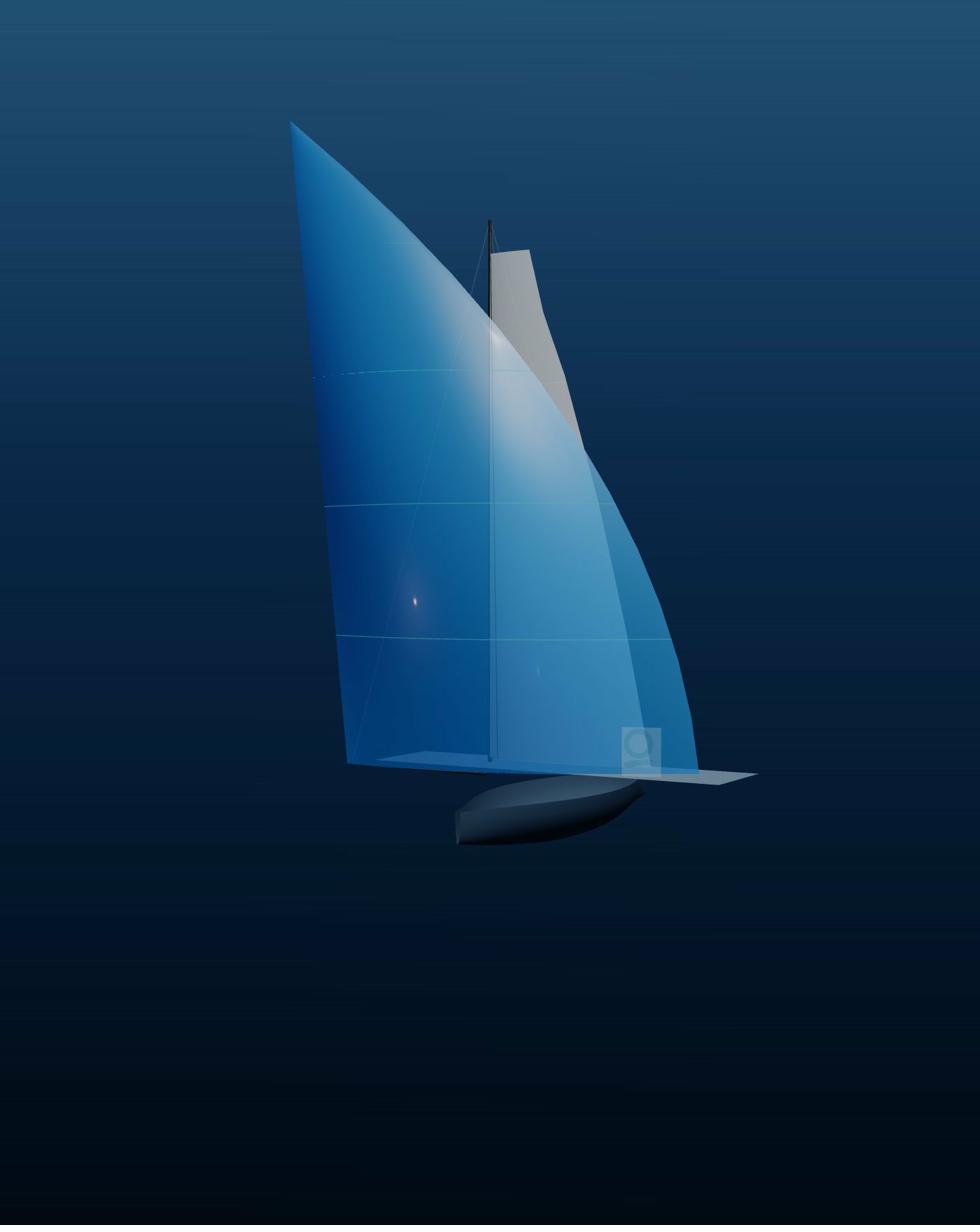
Actual Quantum Sails Mn-25 sail rendering in the live application
CE is one piece of the force balance. See how drive, side force, heel, and depower all connect. The Physics →
Per-Sail and Combined
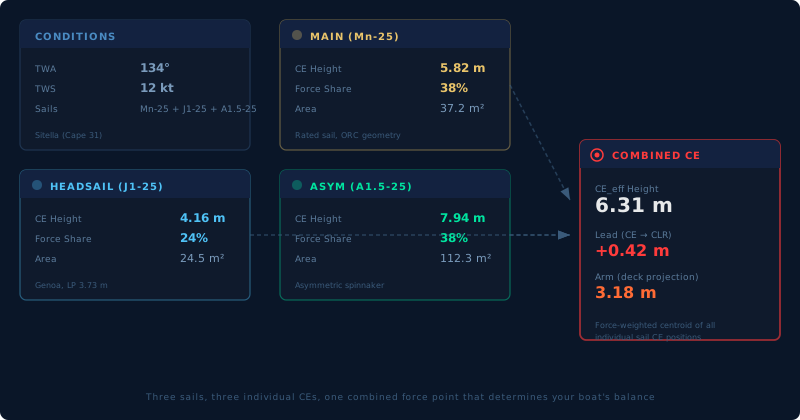
Every sail has a CE. Together they have one.
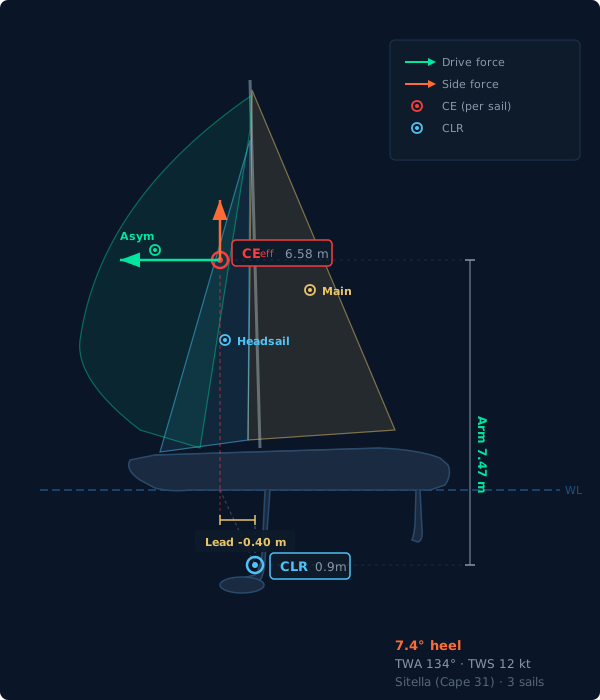
SailrScience computes CE individually for each sail — main, headsail, code sail —
and then calculates the force-weighted combined CEeff that represents
where the total aerodynamic force acts on your boat. The combined CE marker points
straight down to the deck, showing you exactly where the resultant force meets
the hull. This is the number that matters for balance.
Sitella (Cape 31) broad reaching at TWA 134°, 12 kt — Main (Mn-25), Headsail (J1-25), Asymmetric (A1.5-25)
More area moves CE forward and higher. Your digital twin shows exactly where
CE lands with the new sail at every wind angle — before you spend the money.
Balance Problem
Why are we fighting the helm at 16 knots?
CE is too far aft, too high, or both. See CE position at 16 kt with your
current plan — and what happens when you switch to the jib, add a reef, or both.
Reef Timing
When does reefing actually pay off?
Reefing reduces area but lowers CE height, cutting heel moment. At some wind
speed, reduced heel gives back more than the lost area costs. CE shows you
where that crossover is.
Sail Loft — Design Iteration
How does this sail shape move CE across the wind range?
For sailmakers iterating on a design, CE tracks how planform changes shift
the force application point. Different roach, different LP, different CE
trajectory — visible across every regime.
The Full Picture
CE meets CLR — the balance that defines your boat
Center of Effort above the water. Center of Lateral Resistance below it. The
relationship between them determines whether your boat has weather helm, lee helm,
or neutral balance. SailrScience computes both — and shows you how every sail
change, reef, or furl shifts that balance.
When the mainsail blankets the headsail at deep angles, occlusion reduces
headsail lift and shifts the combined CE. The balance you see reflects sail
interaction, not just individual sail positions.
This is what experienced sailors feel. When they say "the boat feels
heavy" or "she's balanced beautifully," they're describing the CE—CLR relationship.
SailrScience makes that feel visible — the offset in meters, the resulting rudder
angle, and how it changes with every puff and header. What took decades to develop
as instinct, your crew can now see on screen before leaving the dock.
CEeff — Above
The force-weighted center of all aerodynamic forces. Moves forward with bigger
headsails, moves up with more sail area, drops with reefs. The variable you
control through sail selection and trim.
CLR — Below
The center of all hydrodynamic resistance — keel, rudder, hull. Relatively fixed
by the boat’s design but shifts dynamically with boat speed and heel angle. The
anchor point that CE pushes against.
CLR (Center of Lateral Resistance) — the underwater pivot point where
hydrodynamic side forces act on the hull and keel.
Lead
The horizontal distance between CE and CLR — the offset that creates helm.
CE ahead of CLR means lee helm. CE aft of CLR means weather helm. In sign
convention terms, positive Lead is forward (lee helm), negative is aft (weather
helm). A few tenths of a meter is the difference between a balanced boat and one
that fights you.
Heel Arm
The vertical distance from CE down to CLR — the lever that turns side force
into heeling moment. Higher CE, longer arm, more heel. Reef the main and the arm
shortens before the force drops. That’s why a first reef often feels like
free speed.